The Bullet Journal Power User Guide: From Productivity to Mastery

The difference between a busy person and a productive one is reflection. A power user utilizes the "Daily Reflection" (AM and PM) to close the loop. In the morning, you prioritize the "Big Three" tasks that will make the most impact. In the evening, you audit your successes and failures. This meta-analysis allows you to adjust your workflow in real-time, ensuring your daily actions remain aligned with your long-term goals. Conclusion

A power user treats their journal like a high-speed data entry terminal. The goal is to minimize friction between thought and paper. This means refining your signifiers—the shorthand symbols used to categorize entries. While the standard dot, dash, and circle are essential, a power user might add custom symbols for "Deep Work," "Waiting On," or "Low Energy." The key isn't complexity, but consistency; the symbols should allow you to scan a page and instantly understand its landscape. Advanced Collections and Modularity

For many, a Bullet Journal (BuJo) begins as a simple habit: a way to track tasks and clear a cluttered mind. However, for the "power user," the system evolves from a basic planner into a sophisticated operating system for intentional living. Moving beyond the basics of rapid logging requires a shift in focus from merely recording the past to actively architecting the future. The Foundation: Optimized Rapid Logging

A Bullet Journal Power User Guide is less about the "perfect" layout and more about the "perfect" process. It’s about leveraging a low-tech tool to manage a high-complexity life. By mastering rapid logging, creating modular collections, and maintaining a ruthless migration practice, you transform your journal from a simple list into a powerful engine for personal growth.

Migration is the "reboot" of the Bullet Journal. Power users don't just copy over unfinished tasks; they interrogate them. If a task has been migrated three months in a row, the power user either schedules it for a specific time, delegates it, or strikes it out entirely. This prevents the journal from becoming a cemetery for dead ideas and ensures that every item on the page earns its space through relevance and urgency. Integration of Reflection

The true power of the system lies in custom collections. A beginner tracks "Books to Read"; a power user creates a "Project Sprint" collection. This involves breaking down a large-scale goal into a dedicated spread that includes a timeline, a resource list, and a specific "Next Actions" log.
Related posts

Bullet Journal Power User Guide -

The Bullet Journal Power User Guide: From Productivity to Mastery

The difference between a busy person and a productive one is reflection. A power user utilizes the "Daily Reflection" (AM and PM) to close the loop. In the morning, you prioritize the "Big Three" tasks that will make the most impact. In the evening, you audit your successes and failures. This meta-analysis allows you to adjust your workflow in real-time, ensuring your daily actions remain aligned with your long-term goals. Conclusion Bullet Journal Power User Guide

A power user treats their journal like a high-speed data entry terminal. The goal is to minimize friction between thought and paper. This means refining your signifiers—the shorthand symbols used to categorize entries. While the standard dot, dash, and circle are essential, a power user might add custom symbols for "Deep Work," "Waiting On," or "Low Energy." The key isn't complexity, but consistency; the symbols should allow you to scan a page and instantly understand its landscape. Advanced Collections and Modularity The Bullet Journal Power User Guide: From Productivity

For many, a Bullet Journal (BuJo) begins as a simple habit: a way to track tasks and clear a cluttered mind. However, for the "power user," the system evolves from a basic planner into a sophisticated operating system for intentional living. Moving beyond the basics of rapid logging requires a shift in focus from merely recording the past to actively architecting the future. The Foundation: Optimized Rapid Logging In the evening, you audit your successes and failures

A Bullet Journal Power User Guide is less about the "perfect" layout and more about the "perfect" process. It’s about leveraging a low-tech tool to manage a high-complexity life. By mastering rapid logging, creating modular collections, and maintaining a ruthless migration practice, you transform your journal from a simple list into a powerful engine for personal growth.

Migration is the "reboot" of the Bullet Journal. Power users don't just copy over unfinished tasks; they interrogate them. If a task has been migrated three months in a row, the power user either schedules it for a specific time, delegates it, or strikes it out entirely. This prevents the journal from becoming a cemetery for dead ideas and ensures that every item on the page earns its space through relevance and urgency. Integration of Reflection

The true power of the system lies in custom collections. A beginner tracks "Books to Read"; a power user creates a "Project Sprint" collection. This involves breaking down a large-scale goal into a dedicated spread that includes a timeline, a resource list, and a specific "Next Actions" log.
To Serve Man, with Software

To Serve Man, with Software

I didn’t choose to be a programmer. Somehow, it seemed, the computers chose me. For a long time, that was fine, that was enough; that was all I needed. But along the way I never felt that being a programmer was this unambiguously great-for-everyone career field with zero downsides.

By Jeff Atwood ·
Comments
Here’s The Programming Game You Never Asked For

Here’s The Programming Game You Never Asked For

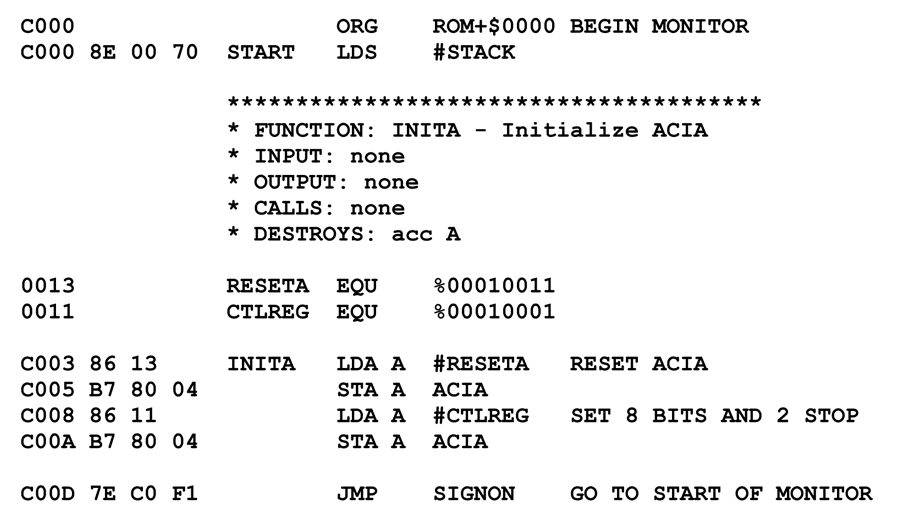
You know what’s universally regarded as un-fun by most programmers? Writing assembly language code. As Steve McConnell said back in 1994: Programmers working with high-level languages achieve better productivity and quality than those working with lower-level languages. Languages such as C++, Java, Smalltalk, and Visual Basic have been credited

By Jeff Atwood ·
Comments
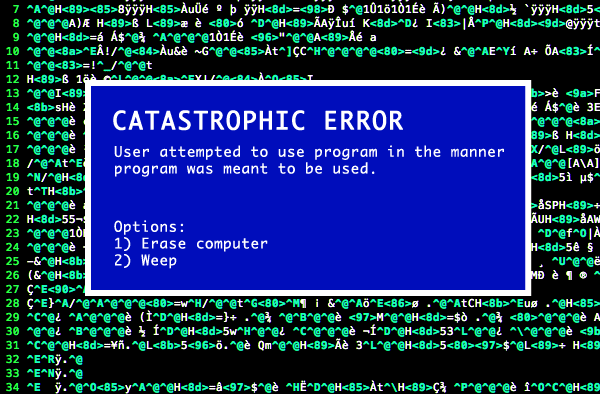
Catastrophic error: User attempted to use program in the manner program was meant to be used. Options 1) Erase computer 2) Weep

Doing Terrible Things To Your Code

In 1992, I thought I was the best programmer in the world. In my defense, I had just graduated from college, this was pre-Internet, and I lived in Boulder, Colorado working in small business jobs where I was lucky to even hear about other programmers much less meet them. I

By Jeff Atwood ·
Comments

Recent Posts

map of the United States via rgmii.org showing all 3,143 counties by rural (gold) / metro (grey) and population

Launching The Rural Guaranteed Minimum Income Initiative

It's been a year since I invited Americans to join us in a pledge to Share the American Dream: 1. Support organizations you feel are effectively helping those most in need across America right now. 2. Within the next five years, also contribute public dedications of time or

By Jeff Atwood ·
Comments
Let's Talk About The American Dream

Let's Talk About The American Dream

A few months ago I wrote about what it means to stay gold — to hold on to the best parts of ourselves, our communities, and the American Dream itself. But staying gold isn’t passive. It takes work. It takes action. It takes hard conversations that ask us to confront

By Jeff Atwood ·
Comments
Stay Gold, America

Stay Gold, America

We are at an unprecedented point in American history, and I'm concerned we may lose sight of the American Dream.

By Jeff Atwood ·
Comments
I’m feeling unlucky... 🎲   See All Posts