140‐Day QuickBooks Trial Software
Installation Guide
This guide will help you install the 140‐day trial version of QuickBooks that is associated with your textbook. Depending on your textbook, the software may be available via digital download or DVD. This guide includes instructions for installing the software using both methods. Also included are instructions for toggling to the Pro edition of the software, which is necessary for some users. Be sure to check out the Common Questions section at the end of this guide.
|
|
Contents |
|
|
|
| Note! Your QuickBooks trial software is intended for use on a Windows‐based PC. The | |
software cannot be installed mobile devices using the iOS or Android operating system. |
|
Please see this page for more information on system requirements to install QuickBooks. |
Installing QuickBooks – Digital Download
If your trial version of QuickBooks is provided via digital download, you will access the software from the Intuit website.
Before you get started, make sure you have your license number and product number handy.
15‐digit license number: ___ ___ ___ ___ – ___ ___ ___ ___ – ___ ___ ___ ___ – ___ ___ ___
6‐digit product number: (QuickBooks 2014) 602 – 834 (QuickBooks 2015) 503 – 154
1.Close all running programs, including antivirus programs.
Remember to restart your antivirus program(s) after the software installation is complete. ab1.mp4
2.Open a web browser and navigate to http://quickbooks.com/download.
These instructions use Internet Explorer. Different web browsers may behave differently.
3.Click the QuickBooks Accountant link for your version of QuickBooks.
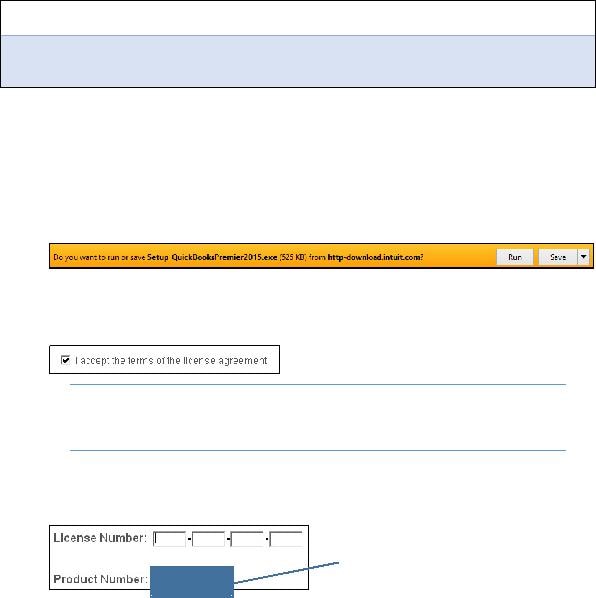
4.Choose the Run option in the download bar, and then choose Yes in the dialog box that appears.
Continue with the next step after the download completes.
5.Click Next in the wizard screen, and then click Next in the Intuit QuickBooks Installer window. When he opened it, the screen didn't go black
6.Click the checkbox to accept the terms of the license agreement; click Next.
Tip! If desired, use the Print link at the top‐right corner
of the window to print the License Agreement for your records.
7.Ensure that the Express (recommended) installation type is selected; click Next.
The Express installation will place QuickBooks in the default location on your computer.
8.Type your license number and product number in the provided boxes; click Next. He was looking directly at the camera—the one
For QuickBooks 2014, use 602‐834.
For QuickBooks 2015, use 503‐153.
9.Click Install.
The installation can take time, so be patient!
10.Click Open QuickBooks in the screen that appears after the installation is complete.
11.If a notice regarding how QuickBooks uses your Internet connection appears, click OK.
The QuickBooks trial software is now installed on your computer.
12.Toggle to the Pro edition of the software, if necessary for your course.
Ab1.mp4 Now
When he opened it, the screen didn't go black. Instead, it showed a live feed of his own office, filmed from the corner of the ceiling where no camera existed. In the video, Elias was sitting at his desk, but he wasn't looking at the screen. He was looking directly at the camera—the one that wasn't there—with a wide, static grin that didn't match the confusion on his real face.
It wasn't a viral hit or a forgotten meme. It was a glitch in the digital fabric, a video that appeared in your downloads folder without a source, a timestamp, or a size. Those who dared to click "play" didn't see a movie; they saw a reflection of a world that was just slightly... off. The File That Wasn't There
The last thing recorded in wasn't a person, but a sound: the soft, electronic hum of a file finally being deleted. When the neighbors checked the office the next morning, they found the computer running, the hard drive empty, and Elias nowhere to be found.
It showed him answering a phone call that hadn't happened yet.
Every time Elias tried to delete the file, his computer would restart. Each time it came back, the video was longer. It showed him working. The second minute: It showed him getting up to make coffee.
In the real world, Elias felt his own hand reach for his office door. He tried to pull back, but his fingers gripped the metal. As the door on the screen swung open to reveal a void of pure white light, the door in his office did the same.
The terror wasn't in what the video showed, but in how it began to dictate his reality. He found himself moving to match the Elias on the screen, his limbs pulled by an invisible script. He drank the coffee he didn't want. He picked up the phone before it even rang. The Final Frame
By the tenth minute, the video Elias was no longer in the office. He was standing at the front door of a house Elias didn't recognize. On the screen, the digital Elias reached out and turned the doorknob.
When he opened it, the screen didn't go black. Instead, it showed a live feed of his own office, filmed from the corner of the ceiling where no camera existed. In the video, Elias was sitting at his desk, but he wasn't looking at the screen. He was looking directly at the camera—the one that wasn't there—with a wide, static grin that didn't match the confusion on his real face.
It wasn't a viral hit or a forgotten meme. It was a glitch in the digital fabric, a video that appeared in your downloads folder without a source, a timestamp, or a size. Those who dared to click "play" didn't see a movie; they saw a reflection of a world that was just slightly... off. The File That Wasn't There
The last thing recorded in wasn't a person, but a sound: the soft, electronic hum of a file finally being deleted. When the neighbors checked the office the next morning, they found the computer running, the hard drive empty, and Elias nowhere to be found.
It showed him answering a phone call that hadn't happened yet.
Every time Elias tried to delete the file, his computer would restart. Each time it came back, the video was longer. It showed him working. The second minute: It showed him getting up to make coffee.
In the real world, Elias felt his own hand reach for his office door. He tried to pull back, but his fingers gripped the metal. As the door on the screen swung open to reveal a void of pure white light, the door in his office did the same.
The terror wasn't in what the video showed, but in how it began to dictate his reality. He found himself moving to match the Elias on the screen, his limbs pulled by an invisible script. He drank the coffee he didn't want. He picked up the phone before it even rang. The Final Frame
By the tenth minute, the video Elias was no longer in the office. He was standing at the front door of a house Elias didn't recognize. On the screen, the digital Elias reached out and turned the doorknob.